Backgrounds
A background is the quickest way to change what a diagram feels like. The same boxes and arrows read very differently on a chalkboard than on graph paper.
Choosing one
Page ▸ Background… (Cmd+Alt+B), or the Page Background button near the bottom of the tool palette.
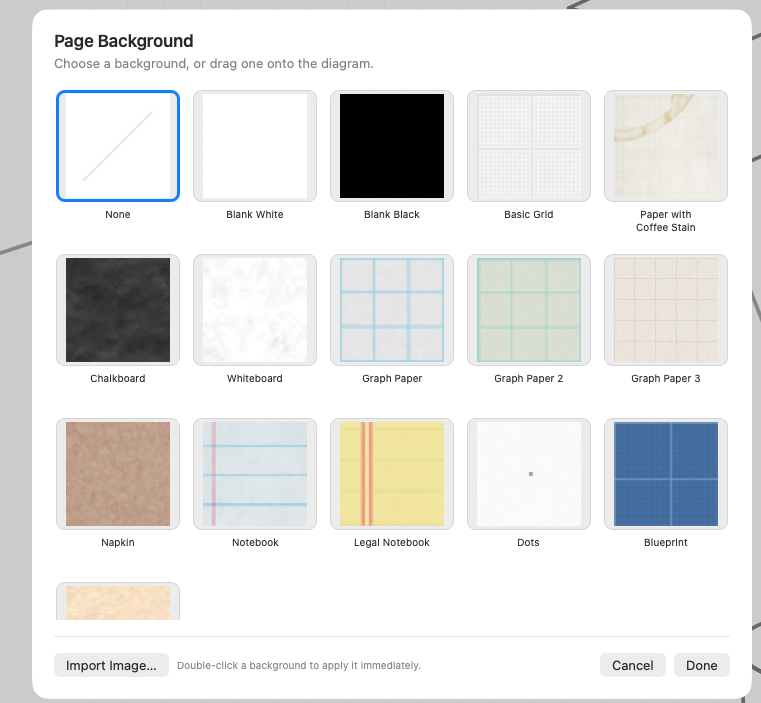
Click a tile to select it, double-click to apply it straight away, or drag a tile onto the canvas. Done applies your choice; Cancel leaves things alone.
What ships with the app
Two solids — Blank White and Blank Black — and thirteen images:
Basic Grid · Paper with Coffee Stain · Chalkboard · Whiteboard · Graph Paper · Graph Paper 2 · Graph Paper 3 · Napkin · Notebook · Legal Notebook · Dots · Blueprint · Vanilla Paper
There's also None, if you want nothing at all behind your work.
Adjusting an image background
Pick an image background and a few controls appear.
Appearance
- Layout — Actual Size, Tile, or Stretch to Reference Frame. Most of the paper textures tile; the ones that are a single sheet (coffee-stained paper, napkin, both notebooks) sit at actual size.
- Tint — tick it and choose a colour to push the background towards it.
- Opacity — how strongly the image shows. Defaults to 25%, which keeps a texture present without fighting your diagram.
Reference Frame
Tick Retain Background Reference Frame to pin the background to a specific rectangle rather than the whole canvas. Type the X, Y, width and height, or use Fit to Artwork or Page Reference to fill them in.
This matters when you're stretching a background: without a frame, "stretch" has nothing to stretch to.
Solid colours
Pick Blank White or Blank Black and you get a Background Color control — which accepts any colour, not just white or black. A pale cream or a soft grey often reads better on screen than pure white.
Your own background image
Import Image… in the chooser takes any ordinary image and embeds it in the document, so the file travels with your diagram. Once imported, it gets the same Layout, Tint, Opacity and Reference Frame controls as the built-ins.
The previously imported image stays available in the chooser as Current / Imported Background, so you can switch away and come back.
Tip
Backgrounds are per page. If you want the same one everywhere, set it on one page and duplicate that page (Cmd+Shift+D) instead of choosing it again each time.
Backgrounds and export
When you export or copy as an image you get to decide whether the background comes along — there's an Include Page Background checkbox in the Export panel, and a separate Copy as Image without Page Background command in the Edit menu.
Handy when a chalkboard looks great in a presentation but you need a transparent PNG to drop into a document.