The window
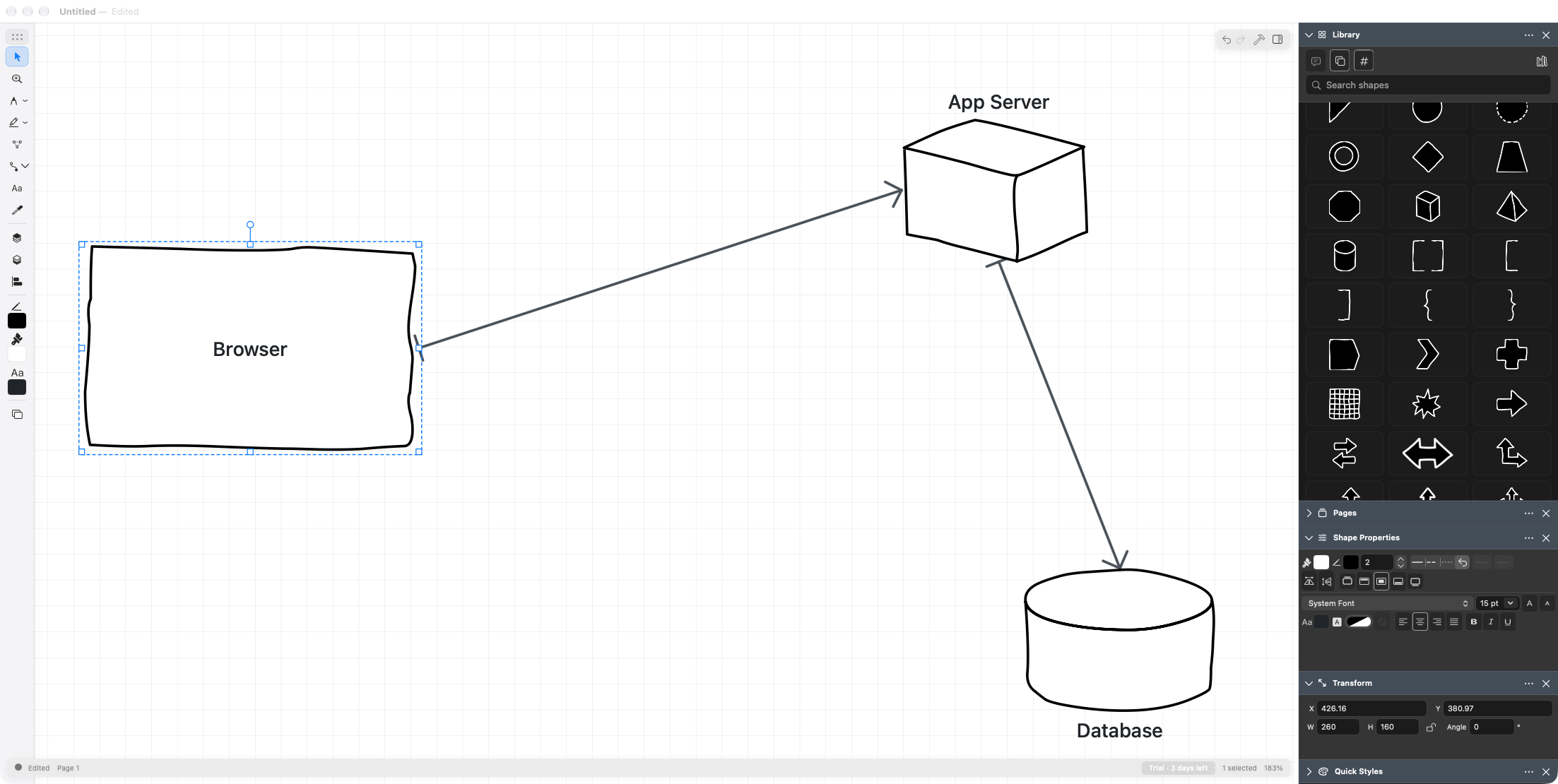
There are only four things in the SimpleDiagrams window: the canvas, the tool palette, the panels, and the status bar. Learn where they are once and you're set.
The canvas
The big area in the middle. It's infinite — there's no page edge to bump into and no "fit to page" to fight with. Draw wherever you like and worry about output size later, when you export or print.
A few things float over the canvas:
- Undo and redo buttons, top right.
- A hammer button that shows and hides the tool palette.
- A sidebar button that shows, hides and repositions every panel.
- The Overview navigator, if you've turned it on (Cmd+Shift+O).
The tool palette
A narrow strip of tools, docked on the left by default. Top to bottom:
| Tool | Key | What it does |
|---|---|---|
| Select | V | Click, drag, resize, rotate. Your home base. |
| Zoom | Z | Click to zoom in, Shift-click to zoom out, drag a box to zoom to it. |
| Pencil | P | Freehand, smoothed. |
| Marker | M | Freehand, chunkier and unsmoothed. |
| Polyshape | G | Click point to point to build a shape. |
| Connector | L | Lines that attach to shapes. |
| Text | T | Click or drag a text box. |
| Eyedropper | I | Copy a style from one object to another. |
Below the tools: Bring to Front, Send to Back, Align or distribute, then the three colour chips (stroke, fill, text), then Page Background, then a ⋯ menu for moving the palette around.
The Pencil, Marker and Connector buttons have a small chevron. Click it for options — line weight for the drawing tools, and Straight / Curved / Squiggly for connectors.
Tools with no button
Four more tools exist on the keyboard only: Rectangle (R), Ellipse (O), Note (N) and Pan (H). Click to drop one at a default size, or drag out the exact frame you want.
Tool letters only work when the canvas has focus and you're not holding Cmd, Ctrl or Alt.
The panels
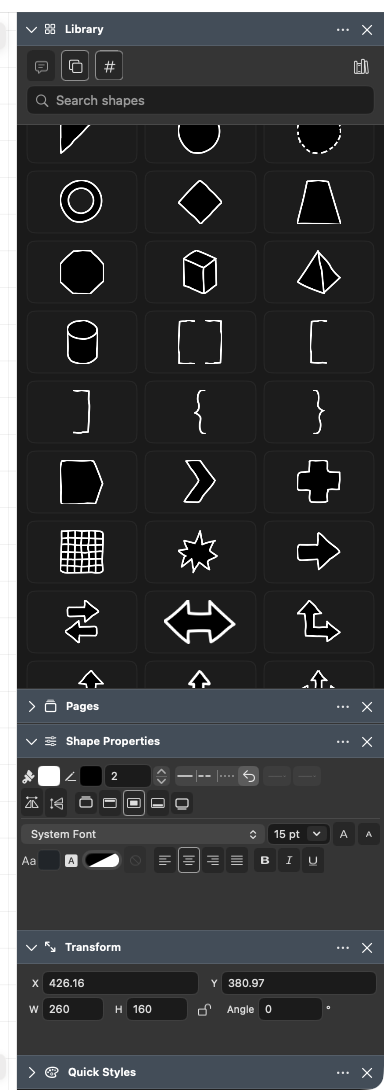
Five panels, docked on the right. Only Library is open the first time you run the app; the rest are collapsed so they don't crowd you.
| Panel | Shortcut | What's in it |
|---|---|---|
| Pages | Cmd+Alt+1 | Every page in the document, with thumbnails. |
| Library | Cmd+Alt+2 | Shapes, search, favourites, library management. |
| Transform | Cmd+Alt+3 | Exact X, Y, width, height and angle. |
| Shape Properties | Cmd+Alt+4 | Fill, stroke, line weight, fonts, text position, flips. |
| Quick Styles | Cmd+Alt+5 | Saved fill/stroke combinations. |
Moving panels around
Each panel is in one of four states: Dock on Left, Dock on Right, Float, or hidden. Three ways to change that:
- Drag the panel's header. Drop it elsewhere in the dock to reorder (you'll see a blue insertion line), drag it to the other side of the window, or pull it off entirely to float it as its own little window.
- Click the ⋯ button in the panel header.
- Use the View menu — View ▸ Panels to show and hide, and View ▸ Library Position (and friends) to move them.
Click a docked panel's header to collapse or expand it. Drag the divider between the dock and the canvas to make the whole column wider or narrower.
If it all goes wrong
Settings ▸ Reset Workspace… puts every panel back where it started. Your diagrams aren't touched — this is layout only.
Dark panels, light panels
The panels default to dark, which most people find easier next to a bright canvas. If you'd rather they matched the rest of your Mac, use View ▸ Panel Appearance ▸ Light. The app itself follows your system light/dark setting regardless.
The status bar
The thin strip along the bottom tells you, left to right:
- whether the document is Saved, Edited, or Imported — save to convert
- the current page name
- your trial or purchase status, if you haven't bought yet
- how many objects are selected
- the current zoom percentage
The Tool Palette and panels in one menu
If you've hidden something and can't remember which menu it lives in, click the sidebar button at the top right of the canvas. Every panel is listed there with Show/Hide, Dock on Left, Dock on Right and Float.